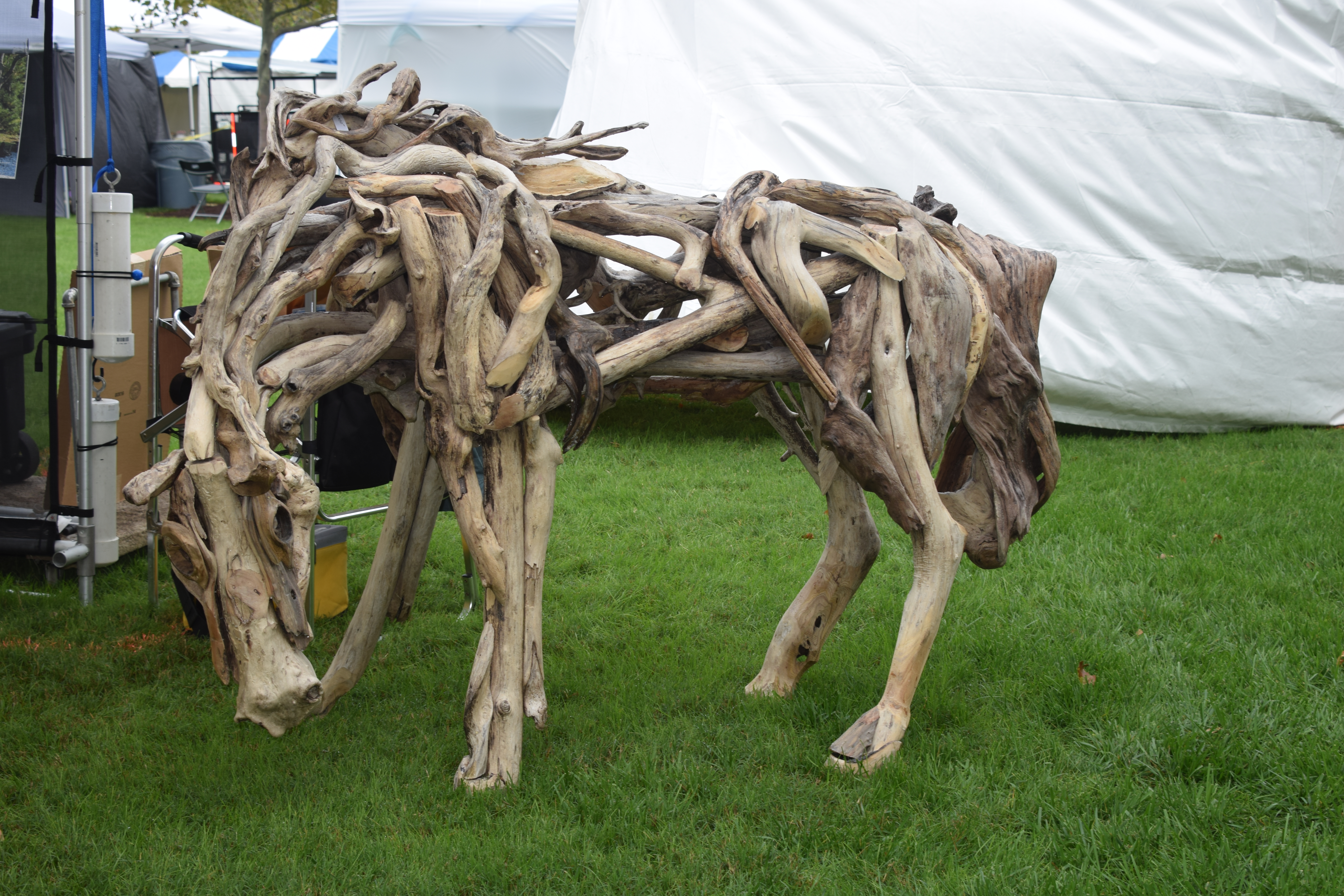
Assembling driftwood into coherent forms presents a set of problems that differ from both conventional woodworking and from sculpture in fabricated materials. The wood is irregular in shape, variable in moisture content, and still subject to dimensional movement. Any method that ignores those properties produces pieces that develop structural problems — cracked joints, warped forms, loosened fasteners — within a few seasons.
Preparation: Drying and Sorting
Freshly beached driftwood has higher moisture content than its bleached appearance suggests. The surface layers are dry but the interior of denser pieces — particularly large Douglas fir logs — can retain significant moisture for months after removal from the beach. Wood that is fastened while still at elevated moisture content will shrink as it equilibrates to interior conditions, placing stress on any joint that constrains that movement.
The standard recommendation is to allow collected pieces to dry in a covered, ventilated space for a minimum of three to six months before use in any structural application. Thinner branches and small pieces can often be considered stable after six to eight weeks. End-grain surfaces dry fastest; the interior of large pieces may need a full year. Weighing individual pieces periodically and noting when the weight stabilizes is a more reliable indicator than time elapsed alone.
Sorting by Grain and Structural Role
Before assembly, it is useful to sort collected material by the role it will play in the finished piece. Pieces that will bear load — the spine of an animal form, the horizontal member of a wall piece — should be selected for straightness, density, and freedom from through-cracks. Decorative surface pieces can be more irregular. Pieces with interesting surface features — borer channels, marine growth scars, unusual grain patterns — are typically reserved for visible positions where those features contribute to the composition.
Fastening Methods
Stainless Steel Screws and Threaded Rod
Stainless steel screws are the most common fastener in driftwood assemblages intended for any durability. Galvanized and zinc-coated screws react with the salts retained in weathered driftwood and produce dark staining around the fastener within months; stainless avoids this. For heavy structural connections — joining a large limb to a central trunk form — threaded stainless rod with corresponding nuts and washers distributes load better than individual screws and allows disassembly if needed.
Pre-drilling is necessary in most driftwood, particularly in dense pieces like Douglas fir; driving screws without a pilot hole splits pieces that appear structurally sound. The pilot hole should be 80–90% of the screw shank diameter, and the depth should account for the screw's full insertion length.
Adhesives
For secondary joints and surface attachments, two-part polyurethane construction adhesive (such as formulations in the PL series, widely available in Canada) bonds well to dry driftwood and tolerates the small amounts of continued dimensional movement that even well-dried driftwood exhibits. Standard wood glue (PVA) is suitable for close-fitting, dry joints in indoor pieces but fails in outdoor applications. Cyanoacrylate (CA) glue bonds fast but has limited gap-filling ability and is brittle under stress — it is useful for fixing small surface fragments in position before applying a structural adhesive, not as a structural fastener itself.
Wire and Lashing
For compositions where visible fasteners are acceptable or desirable, copper or stainless wire lashing has a long precedent in coastal craft traditions. Copper wire develops a patina over time that can integrate visually with the grey tones of aged driftwood. The mechanical advantage of lashing is limited compared to screws for structural load, but for decorative attachments and small-scale assemblages it is adequate and leaves the wood surface undamaged.
Freestanding Structure
Freestanding driftwood sculpture faces the same engineering constraints as any freestanding structure: the centre of mass must be over the support base, and the base must provide sufficient resistance to tipping forces. Large pieces — particularly animal forms or tall vertical columns — may require an internal armature of steel rod or pipe anchored in a weighted base, with the driftwood elements attached around it.
A common approach for outdoor freestanding pieces is to set a length of 1/2-inch galvanized pipe in concrete or a heavy stone base, then assemble the driftwood form around the pipe using screws driven into the pipe through pre-drilled holes. The pipe carries the structural load; the wood carries the visual form. This approach also allows individual elements to be replaced if one piece deteriorates faster than the others.
Wall-Mounted Pieces
Wall-mounted driftwood assemblages require backing material rated for the total weight of the piece. MDF and standard particleboard are not appropriate for pieces that will be installed in spaces with humidity variation — both materials swell noticeably with moisture and will cause the composition attached to them to distort. Exterior-grade plywood (spruce or Baltic birch, minimum 3/4-inch for heavy pieces) is the standard choice for backing that will remain dimensionally stable.
The backing should be sealed on all surfaces — including edges — before attachment to the wall, to slow moisture exchange. Hanging hardware should be rated for at least twice the actual weight of the piece, because driftwood weight is difficult to assess accurately in the field.
Surface Treatment
Whether to apply any finish to assembled driftwood is a choice that affects both appearance and longevity. For indoor pieces, no finish is necessary to preserve the material — dry driftwood is chemically stable indoors. Some practitioners apply a single coat of clear matte wax (paste wax or a hard wax oil formulation) to prevent dust absorption and to bring out grain detail without adding visible sheen. Penetrating oil finishes darken the wood and are generally avoided if the goal is to retain the characteristic pale grey of weathered driftwood.
For outdoor pieces, a penetrating wood stabilizer rated for exterior exposure extends the lifespan of the piece by slowing re-wetting and drying cycles. Regular reapplication — typically every two to three years — maintains protection. Even with treatment, outdoor driftwood assemblages are generally considered temporary structures with an expected lifespan measured in years rather than decades in most Canadian climates.
Technical references: Canadian Wood Council published data on moisture content and dimensional movement in coastal softwood species; published work on marine borer distribution and effects on wood density in BC coastal waters.